

Tezos is a decentralized platform that offers users the ability to create and deploy smart contracts and decentralized applications. Tezos is also capable of self-amending, meaning that it can upgrade itself without the need for hard forks.
The benefits of using Tezos include its security, stability, and scalability. However, there are also some disadvantages to using Tezos, such as relatively low usage. As Tezos continues to grow and evolve, it is likely that it will become an increasingly popular platform for developers and users alike. If you’re interested in getting started with Tezos, keep reading to see if Tezos is right for you!
Who Founded Tezos Blockchain?
Tezos is a decentralized blockchain that launched in 2018. The Tezos Foundation, the project’s main backer, is based in Switzerland. The foundation’s president is Johann Gevers, who also serves on the board of directors. Tezos was created by Arthur Breitman, a former hedge fund analyst. The project’s other co-founder is his wife, Kathleen Breitman.
Which Financial Institutions Invest in Tezos?
The Tezos Foundation, a Swiss nonprofit, originally funded the development of the Tezos protocol in 2014. Since then, Tezos has raised over $232 million from a variety of financial institutions. Prominent backers include Tim Draper’s venture capital firm DFJ, cryptocurrency investment firm Polychain Capital, and Binance Labs. Tezos has become one of the most well-funded blockchain projects in the world.
What Teams Are Working on Tezos Development?
The core team is based in Switzerland and is led by founder Arthur Breitman. Other notable members of the team include senior engineer Tillman Vogt and former Googler Guido Schmitz-Krummenacher. While the development of Tezos is ongoing, it has already progressed significantly and is currently functional. The mainnet has processed over $1 billion worth of transactions.
How Does the Tezos Blockchain Work?
Tezos is a decentralized platform that enables users to create and deploy Tezos smart contracts and decentralized applications. The platform is powered by its native coin Tez, with a symbol of $XTZ.
Underlying the Tezos protocol is a proof-of-stake consensus mechanism that allows token holders to participate in validating and verifying transactions on the blockchain. When a block of transactions is created, token holders who have staked their $XTZ can choose to delegate their tokens to one of the block creators, who will then validate the block and receive a reward for their work.
In addition to $XTZ, Tezos also supports other crypto assets through its smart contract functionality. For example, users can create an ERC-20 token on Tezos and then use it within their dApp or smart contract.
Benefits of Using Tezos Blockchain
Tezos allows for the development and deployment of smart contracts and decentralized applications. Tezos also supports token holdings, which can be used to represent assets or fungible tokens. Tezos is highly scalable, meaning that it can support a large number of transactions without compromising on speed or security. Tezos has a large and active community of developers who are constantly innovating and expanding the platform’s capabilities.
Disadvantages of Using Tezos Blockchain
Tezos has been praised for its security and stability, but it also has some disadvantages. One disadvantage of Tezos is that it is not as widely used as other blockchain networks. This means that there are fewer Tezos-compatible wallets and exchanges, and Tezos tokens can be more difficult to buy and sell. In addition, Tezos has a relatively high minimum stake, which may make it cost-prohibitive for some users. Finally, Tezos tokens cannot be sent to addresses on other blockchain networks, which limits their usefulness.
The Tezos Ecosystem
According to the Tezos website, 91 “entities and applications” are supported in the Tezos ecosystem. A further look reveals 9 categories of entities and applications. Notable examples include:
Block Explorers
A blockchain explorer is a tool that allows users to view and search the data stored on a blockchain.
Notable example: TezBlock is a popular block explorer for the Tezos blockchain that offers features such as transaction analysis and address tagging.
Baking Tools
Baking tools are used by Tezos token holders to delegate their tokens and participate in block creation. Delegating tokens simply means that you are allowing someone else to use your tokens to validate blocks on Tezos. When you delegate your tokens, you are essentially entrusting them to another user who will then use them to validate blocks and earn rewards. Delegating your tokens is a way of participating in block creation without having
Notable example: Bake Buddy is a baking tool that allows users to easily delegate their $XTZ tokens and participate in block creation.
Community
Every crypto project needs to build its community. Tezos is no different. Tezos offers 11 community-building tools ranging in scope, application, and region of use.
Notable Example: Teia is used for trading various digital assets including NFTs. Teia is literally owned, operated, and maintained by the Tezos community. Additionally, Teia is improved based on participant input.
DeFi
DeFi (decentralized finance) is a growing industry that offers financial services and products that are built on various blockchains. DeFi applications are often referred to as dApps. Tezos currently supports 20 DeFi dApps.
Notable Example: Vortex Protocol is the leading DeFi protocol within the Tezos ecosystem. It’s a one-stop shop for most basic DeFi needs such as swapping tokens, providing liquidity, and sending/receiving tokens. On a side note, the U/I for Vortex could use some serious updating, as it’s a pretty heinous eye chart at the moment.
Blockchain Developer Tools
A blockchain developer tool is a piece of software that helps developers to build applications on a particular blockchain, expand functionality, or test their applications on a blockchain. There are many different types of developer tools available, and they vary depending on the blockchain platform that they are designed for.
Notable Example: Chinstrap protocol is described as a “developer environment,” meaning that it’s a testing framework created specifically for Tezos developers. A nice feature is developers can compile different smart contracts, then test them all within the same tool.
NFTs (Non-Fungible Tokens)
A non-fungible token (NFT) is a type of digital asset that is not interchangeable with other assets of the same type. NFTs are unique and each one has its own distinct value. This makes them different from traditional cryptocurrencies, which are fungible and can be exchanged for other assets of the same type.
NFTs can be used to represent a wide range of physical and digital assets, including but not limited to: art, collectibles, gaming items, and digital assets.
Notable Example: InterPop protocol is focused on next-generation comic books, games, and collectible NFT-based fandom. The InterPop Comics section is particularly interesting. There are several fully designed comic book lines for sale and there’s also a free-to-read section. The Abyss has some nice artwork in the free section.

Gaming
Blockchain gaming is a rapidly growing industry that offers gamers the ability to own, trade, and sell in-game items and digital assets. Play-to-earn (P2E) is an all-encompassing term for blockchain gaming.
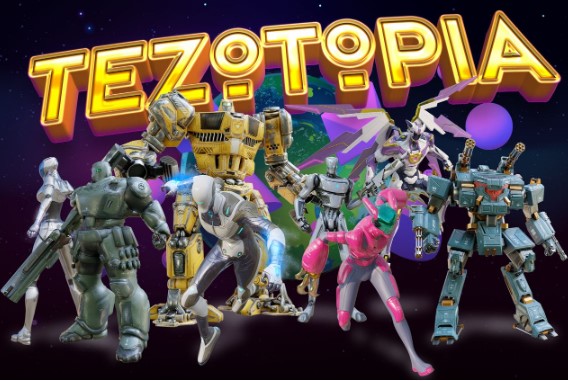
Notable Example: Tezotopia is a P2E game where users can battle each other, create blocks of digital land to become landlords, and collect NFTs. Tezotopia is played in real-time and has sophisticated gaming strategies built in. Do yourself a favor and watch the video trailer. It’s really good.
Digital Identity
A digital identity is an online or electronic identity that is used to identify a person or entity in the digital world. A digital identity can be used for a variety of purposes, including accessing online services, participating in online communities, and conducting transactions.
Notable Example: Gravity is interesting because it enables individuals, organizations, and non-governmental organizations (NGOs) the ability to create private, portable, and persistent digital identities. This could be valuable as migration increases around the globe.
Stablecoins
A stablecoin is a type of cryptocurrency that is designed to minimize price volatility. Stablecoins are backed by assets such as fiat currencies, commodities, or other cryptocurrencies. The aim of a stablecoin is to maintain a stable value regardless of market conditions.
Notable Example: uUSD is an algorithmic stablecoin pegged to the US Dollar. An algorithmic stablecoin is a type of cryptocurrency that uses algorithms to maintain a stable value. uUSD is able to be exchanged and is also backed by the Tezos native currency, $XTZ.
I checked QuipuSwap, and uUSD is available for providing liquidity and farming and is also used for an app called youves, which rewards digital asset creators.
What is On-Chain Governance?
On-chain governance allows token holders to vote on network upgrades. Tezos is one such network that uses on-chain governance. Token holders can vote on proposed amendments to the Tezos protocol. If a supermajority of token holders approve of an amendment, it will be implemented on Tezos.
On-chain governance allows Tezos token holders to have a direct say in how the Tezos network evolves over time. This makes Tezos more decentralized and less reliant on a central authority to make decisions about the future of the network.
Proof-Of-Stake
Proof-of-stake (PoS) is a type of consensus algorithm by which a cryptocurrency blockchain network aims to achieve consensus. Unlike proof-of-work (PoW) based cryptocurrencies (like Bitcoin), in PoS-based cryptocurrencies, the creator of the next block is chosen via various combinations of random selection.
Proponents of PoS argue that it is more efficient than PoW, as it does not require expensive hardware for mining new blocks, and consumes far less electricity. In addition, since there is no need for miners to compete for block rewards, transaction fees should theoretically be lower.
While PoS has been successfully implemented in a number of projects, some have raised concerns about its security and scalability. Nevertheless, proof-of-stake remains one of the most popular choices for consensus mechanisms among new blockchain projects.
Baking
Baking is the process of validating and baking new blocks in the Tezos blockchain. Bakers are rewarded with newly minted $XTZ for their efforts.
First, baking is done by staking $XTZ. This means that bakers must have a certain amount of $XTZ in order to participate.
Second, baking is done on a rolling basis, with different bakers being chosen to bake new blocks at different times. This helps to ensure that the baking process is distributed evenly among all participants. Baking is an important part of the Tezos ecosystem and plays a vital role in keeping the blockchain secure.
How to Get Started With Tezos
First, new users need to create a Tezos-compatible wallet. This can be done through an online service or by downloading and installing software.
Once they have a wallet, they’ll need to acquire some XTZ tokens, the native cryptocurrency of Tezos. This can be done by purchasing XTZ on an exchange or by participating in the Tezos staking program.
Finally, new users will need to register their wallets with the Tezos network. Once they’ve done all of this, they’ll be ready to start using Tezos.
Tezos Wallets
Tezos has many different types of wallets associated with it. There are online wallets, software wallets, and hardware wallets. Online wallets are the easiest to use but are also the least secure. Software wallets are more secure but can be difficult to use. Hardware wallets are the most secure but can be expensive. Below are representatives from each category that are compatible with Tezos:
-Ledger Nano S
-Trezor Model T
-Trust Wallet
-Kukai
-Airgap
The future of the Tezos blockchain
Tezos has already seen some success, with a number of major exchanges and wallets supporting the Tezos token. In the future, Tezos plans to offer formal verification, which would allow developers to mathematically prove that their smart contracts are correct.
Formal verification is a significant technical advance that could make Tezos the go-to platform for developing high-security smart contracts.
Tezos plans to launch a Decentralized Autonomous Organization (DAO), which would allow Tezos token holders to vote on protocol upgrades. The DAO will further decentralize decision-making on the Tezos network and ensure that all stakeholders have a say in the future of Tezos.
Conclusion
Tezos is a decentralized platform that offers users the ability to create and deploy smart contracts and decentralized applications.
The Tezos blockchain is also capable of self-amending, meaning that it can upgrade itself without the need for hard forks.
The benefits of using the Tezos blockchain include its security, stability, and scalability. However, there are also some disadvantages to using the Tezos blockchain, such as fewer compatible wallets.
No one can predict the future, but Tezos does show some promise as long as adoption increases in the coming years.
 Crypto Project Reviews